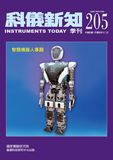
2015.12
About Instruments Today No. 205
Intelligent Robots
Introduction to Intelligent Robots [ 下載 PDF ]
Han-Pang Huang, Zhi-Hao Kang
Intelligent robots can perceive the change of environment, plan trajectory and behavior, interact with human and objects, and then comply with environment. It is expected that intelligent robots will be as popular as today's notebook PCs and everyone will have one in the late 21 century. The relationship between human and robots should be re-defined.
Intelligent Robots in Industry 4.0 [ 下載 PDF ]
Hsien-I Lin, Ming-Feng Hsieh
Industry 4.0 is currently the world's trend of automation technology. For the global manufacturing industry, they need to cope with the problem of labor shortage, the problem of short product cycle time, and the problem of smallvolume, large-variety production, resulting in the current production methods cannot meet the manufacturing demands. However, in Industry 4.0, intelligent robots play a key role because intelligent robots will be able to demonstrate the versatility to replace some of human labor, in order to ease the above-mentioned problems. Compared to industrial robots currently used for simple production work, intelligent robots are endowed with sensing and decision-making abilities to accomplish more complex production work, or even co-work with humans for flexible production. In this article, we mention that should intelligent robots in Industry 4.0 not only think and learn, but also exploit the synergy among essential core technologies in Industry 4.0 such as cloud, big data, and collaborative human-computer interface to improve and optimize manufacturing processes. This article will overview the above aspects.
Grasp Control with Robotic Flexible Piezoelectric Tactile Sensor [ 下載 PDF ]
Cheng-Hsin Chuang, Chien-Liang Mu, Jia-Wun Chen
We have developed a robust and fl exible tactile sensor for use in robotic gripping that can identify dual axis slippage by measuring the dynamic lateral force. The sensor consists of a rigid bump like structure embedded in a soft polydimethylsiloxane (PDMS) packaging and placed on top of a piezoelectric polvinylidene fluoride (PVDF) film that is sandwiched between two flexible printed circuits (FPC). The rigid structure induces two opposite stress states on the PVDF film in the presence of a dynamic lateral force, resulting in a positive (V1) and negative voltage (V3) output at the electrodes located in the compressive and tensile areas, respectively. The sensor sensitivity defined as the voltage output variation depends on the slip acceleration and normal external force exerted on the sensor by the counter weight. From our results, it was observed that the best sensor response corresponding to a voltage output variation of 0.08 V was obtained at an acceleration of 15 mm/s2 and a counter weight of 200 grams. To test its efficacy, the tactile sensor has been mounted on a robot arm and can successfully configure grab conditions by identifying slippage for objects with different weights. Consequently, the tactile sensor can sensitively detect slippage occurrence and direction of lateral force due to two opposite peak voltages occurring simultaneously rather than relying on variation in voltage output as utilized in conventional piezoelectric devices.
Hand Motion System for Real-Time Manipulating 6-Axis Robot Arm [ 下載 PDF ]
Chyi-Yeu Lin, Shu-Han Chung, Chung-Yi Liang
In this paper, 3D displacement information of the featured glove is captured by Kinect and the Euler's angles of the operator's wrist are postured by LPMS-B 6-axis acceleration sensor (from L-P Research) immediately. After that, the 3D displacement information is integrated with Euler's angles into the integral 6-axis information for defining the real-time end-effector position and posture in the robot arm tele-operation. Furthermore, the featured glove was equipped with an Arduino circuit for controlling the on-off operation (grasping or releasing object) of the gripper on the end-effector. This innovative system can be used to control the 6-axis robot arm to operate a randomly-positioned object without pre-teaching. This technique is particularly suitable for operating randomly-positioned objects by using multi-axis robot arm. The operation is intuitive, without the time-consuming teaching process, save time, and increase efficiency. The new system can also be used in generating trajectories for some hard-to-teach or high time-consuming object operations. The trajectory produced by the hand posture operation can be subsequently used on repeated object operations. This is a valuable tool for some hard-to-teach assembly tasks.
Intelligent Passive Robot Walking Helper [ 下載 PDF ]
Chun-Hsu Ko, Kuu-Young Young, Yi-Hung Hsieh
In responding to aging society, robot walking helper has come up as a research focus. To be practical for use in daily lives for the elders, it should be able to follow user intention during maneuver and provide motion assistance when demanded. As quite a number of guidance schemes have been proposed, the study on maneuver is comparatively few. This article introduces a maneuvering system for the passive type of robot walking helper based on user intention. The system first recognizes motion intention from user-applied force and hip rotation, and then utilizes an assistive control strategy to generate proper braking torque for effective maneuver. Experiments in a real environment are conducted for demonstration.
An Introduction to Robot-Based Bin Picking Technology [ 下載 PDF ]
Nelson Yen-Chung Chang, Hsin-Yi Lin
Many loading and unloading tasks in manufacturing, metalworking, and food processing relied on human labor. However, as the issue of labor shortage grew, demand for robot-based automatic loading and unloading grew as well. Most cases which traditional automation found difficult to handle were objects randomly stacked within a container. To pick an object out from a container in such cases is called 'random bin picking (RBP)'. The need for RBP is common for components, intermediate metal parts, and food packages during manufacturing or processing. Robots must be equipped with intelligent vision to determine the pose of objects and pick objects out. This article introduced the background and potential market of RBP first. Then this article briefly described several representing RBP applications in the world. Finally, a concluding remark on future development of RBP technology was given.
Open a Window for Investigating Jurassic Dinosaur Fossil by a Perspective View of Synchrotron [ 下載 PDF ]
Cheng-Cheng Chiang, Pei-Yu Huang, Ching-Iue Chen, Yao-Chang Lee
Synchrotron-radiation-based infrared microspectroscopy and the technique of ultrathin sectioned fossil making in Taiwan Light Source open a new window of paleontology in unfolding mysterious Jurassic embryology and development of serrated teeth of carnivorous dinosaur. Taiwan paleontologists proved the paleontological possibility to reality of preservation of organic remain within 195 Myrs Lufengosaurus embryos, and proposed a novelty of serrated teeth development based on the investigations by using infrared microspectroscopy.
Design and Development of a Continua Cardiovascular Fitness System Using IEEE 11073 Profiles [ 下載 PDF ]
Yuan-Fa Lee
With the increase of health concept and the threat of sport and fitness management, fitness device with communication ability becomes important functionality. Old sports and fitness facilities designed without standard communication protocol were private communication systems. These fitness devices only connect to the specific gateway and server. The ISO/IEEE 11073 specifi cations adopted by the Continua Health Alliance are the international personal healthcare device communication standards. In which, the fitness and activity profiles are included in these standards. By these standards, the fitness devices can intercommunication and exchange measurement data within a single system. In addition, the Bluetooth Health Device Profile defined by Bluetooth SIG is the transport standard for medical devices. The Bluetooth Health Device Profile is seamlessly connected with the ISO/IEEE 11073 Personal Health Device standards to exchange measurement data. The design for the Continua Cardiovascular Fitness system proposed in this paper is based on the Bluetooth Health Device Profi le (HDP) as well as the Continua Design Guidelines V4.0 and ISO/IEEE 11073 Personal Health Device standards. The Continua Cardiovascular Fitness system senses the physical activities from the users, and then transmits these data to the application hosting device (AHD) and server in compliance with IEEE 11073 data format and protocol standards via the Bluetooth HDP interface. Based on the testing results, users can transmit exercise measurement to any application hosting device certified by the Continua Health Alliance over the Bluetooth HDP interface successfully.