2018.10

About Instruments Today No. 216

FORMOSAT-5

FORMOSAT-5 [ 下載 PDF ]

Shih-Ping Tseng

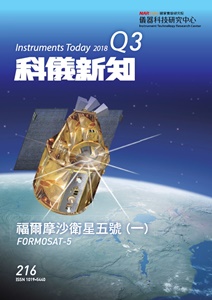
FORMOSAT-5 (FS5) is the first space program that National Space Organization (NSPO) takes full responsibility for the complete satellite systems engineering development including payloads. FS5's success would significantly help NSPO in pursuing future space programs. FS5 mission goals include building up Taiwan's self-reliant space technology on optical Remote Sensing Instrument (RSI) and spacecraft; developing key components of the remote sensing satellite through integrating domestic technical capabilities; serving FORMOSAT-2 (FS2) global user community; promoting space science research.


Command & Data Handling [ 下載 PDF ]

Chih-Long Lin

This paper introduces FORMOSAT-5 C&DH (Command & Data Handling) subsystem related with function, architecture, development fl ow and orbit operation status. C&DH is to receive and handle the ground stations uplink TC (Telecommand). It performs TC to control satellite configurations, adjust attitude, take images and conduct science payload experiments. Simultaneously, it executes FSW (Flight Software) for Power/Thermal/Attitude control. The satellite SOH (Status of Health) data are also collected and downlinked to the ground stations for monitor and analysis. OBC (On Board Computer) is the key component of C&DH. It's first indigenous component in Taiwan. NSPO is responsible for electrical circuit design. NCSIST is responsible for mechanical & thermal design, PCB & chassis productions and assembly.


Introduction to the Communication Sub-systems [ 下載 PDF ]

I-Young Tarn

This article describes the two communications sub-systems on the Formosat-5 satellite, namely the Telemetry and Telecommand (TTC) sub-system and the X-band Downlink System (XDS) sub-system. They have dissimilar goals and operations scenarios. TTC sub-system, a part of spacecraft bus, is in charge of the bilateral communications between the satellite and the S-band TTC ground stations. TTC receives the commands sent by the antenna on ground, and delivers the state of health data of the satellite together with data of Advanced Ionospheric Probe (AIP) payload to the ground antenna. On the other hand, XDS sub-system downloads the compressed and encoded Remote Sensing Instrument (RSI) payload data (image data) to the X-band receiving antenna system on ground.


Electrical Power Subsystem [ 下載 PDF ]

Jia-Jing Yeh

FORMOSAT-5 is the first self-developed spacecraft, including design, analysis, assembly, validation and test, by National Space Organization, Taiwan. The mission is (1) a 2-meter panchromatic / 4-meter multispectral Remote Sensing Instrument, (2) Advance Ionosphere Probe. In addition, there are 5 key spacecraft components developed by domestic agencies, one of them is Power Control and Distribution Unit. Electrical Power Subsystem provides electrical power to spacecraft bus and payload instruments with safety control as well as regulates solar array and battery power to ensure appropriate spacecraft operation in five-year mission life. This paper introduces hardware components, control algorithm, and energy balance analysis of the Electrical Power Subsystem on FORMOSAT-5 spacecraft to support its mission.


The Development Retrospect of Propulsion Subsystem [ 下載 PDF ]

Tien-Chuan Kuo

Current article focuses on some retrospects, concerning the propulsion related mission requirements, subsystem design, analysis, integration, verification and test, and the in-orbit operation, for the self-reliant development of the propulsion subsystem of FORMOSAT-5 satellite. FORMOSAT-5 has equipped a cold gas system, which is a simple, highly safe and reliable system. The experiences gained through the development process and the successful flight operation in orbit will definitely help us to develop the propulsion systems with higher performance for future satellite applications.


Flight Software [ 下載 PDF ]

Hsiao-Chih Meng

FORMOSAT-5 Flight Software and the Flight Computer compose of the central nervous system of the FORMOSAT-5 satellite. They play the role in the satellite as the brain does in human body. All vital atellite subsystem functions are under the persistent planning/coordination/execution/monitoring of the flight software. These vital functions include the Thermal Control Subsystem (TCS), Electrical Power Subsystem (EPS), Attitude & Orbit Control Subsystem (AOCS), Reaction Control Subsystem (RCS), Command & Data Handling Subsystem (C&DH), Telemetry Telecommand and Control (TT&C). This paper introduces the development, verifications and validations strategies taken by the flight software team in developing the FORMOSAT-5 flight software, as well as the difficulties and challenges encountered during the development phase.


Optical Design and Analysis of Remote Sensing Instrument [ 下載 PDF ]

Shenq-Tsong Chang

This article describes the telescope optical design and performance analysis of the Remote Sensing Instrument (RSI) of Formosat-5. The design requirements, design results, tolerance analysis, evaluations of Modulation Transfer Function (MTF) and Signal to Noise Ratio (SNR) are included. Cassegrain telescope design is selected due to the existed experience. The telescope consists of a primary mirror, a secondary mirror and a four-lens corrector. Mirrors are made of Zerodur for very low CTE requirement. Fused silica is selected for corrector lens and band-pass filters to meet radiation resistance requirement in space. The telescope has the focal length of 3,600 mm, and the clear aperture of 450 mm. The analysis results show that the design MTF is diffraction limited, and SNR complies with the requirements of CMOS sensor and RSI.


The Development of Experimental Model of Remote Sensing Instrument [ 下載 PDF ]

Yu-Chuan Lin, Po-Hsuan Huang, Wei-Cheng Lin, Shenq-Tsong Chang, Ming-Yin Hsu, Roger Lien, Fong- Zhi Chen, Kun-Huan Wu, Chia-Yen Chan, Ho-Lin Tsay, Ting-Ming Huang, Po-Han Huang

Experimental model (ExM) of Remote Sensing Instrument (RSI) was developed prior to Proto-Flight Model (PFM). It was planned to verify the design and assembly processes in a short period time in order to gain some experience before PFM. Two versions of ExM were reported, where one used diamond-turned Aluminum mirrors and the other polished Zerodur mirrors. The experiences gained through ExM project is introduced, including optomechanical design and analysis, gluing, CMM-aided alignment and interferometer-aided alignment, et al.


The Study on Design of Digital 3D Vibration Sensing Module [ 下載 PDF ]

Tai-Shan Liao

Vibration sensing technology is usually a basic application in smart machinery and environmental vibration monitoring. In this article, based on the recent development of digital 3D vibration sensing module, this article explains the basic design of digital 3D vibration sensing module, using electronic resonator, three mechanical spring switches, embedded microprocessor unit (MCU) and the event algorithm. And the experimental results show that there can be sampling 125 samples per second. These show that the digital 3D vibration sensing module has the advantages of low cost and high vibration effect, and is suitable for instrument and environmental vibration monitoring applications in the future.


Developing A Broadband Microspectrophotometer and Its Calibration [ 下載 PDF ]

Chun-Jen Weng, Da-Ren Liu, Yu-Hsin Lin

Commercial spectroscopic ellipsometer and polarimeter cannot characterize the properties of the micro-nano structures because of the poor resolution and lower magnification. In this study, we propose to combine the microscope and microspectrophotometer(MSP) to measure the optical polarization in ultra-broadband wavelength range (400 nm-1700 nm). We developed a broadband MSP. This MSP can measure characterization for micronano structures in the range of 400 nm-1700 nm. It will be an advance instrument for frontier researches such as chiral metamaterials, plasmonics, micro polarization optics and bio optics.