2018.12

About Instruments Today No. 217

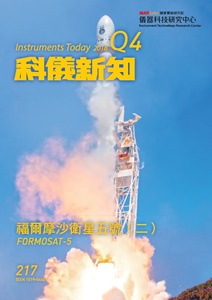
FORMOSAT-5

Remote Sensing Instrument [ 下載 PDF ]

Po-Hsuan Huang

FORMOSAT-5 Remote Sensing Instrument (RSI) is primary payload on FORMOSAT-5 optical remote sensing satellite. RSI will capture earth images by push-broom method from a sun synchronous orbit at 720-km altitude with 98.28-degree inclination angle, which provides 2-m resolution panchromatic (PAN, black & white) and 4-m resolution multi-spectral (MS, color) images. The RSI consists of several sub-systems, including optical sub-system, structure sub-system, thermal control sub-system, focal plane assembly (FPA) and electronic unit (EU). This article will briefly introduces the RSI sub-systems and RSI integration and testing process.


Advanced Ionospheric Probe [ 下載 PDF ]

Chi-Kuang Chao

Advanced Ionospheric Probe (AIP) is a piggyback science payload developed by National Central University for FORMOSAT-5 satellite to explore space weather/climate and seismic precursors associated with strong earthquakes. AIP is an all-in-one plasma sensor that measures in-situ ionospheric plasma concentrations, velocities, and temperatures in a time-sharing way and is capable of measuring ionospheric plasma irregularities at a sample rate up to 8,192 Hz over a wide range of spatial scales. After early orbit checkout, ionospheric plasma parameter profiles will be routinely observed by FORMOSAT-5/AIP in night-side orbits with a geographic latitude coverage from –60° to 60°. These valuable science data shall be available to space community at the end of 2018.


Satellite Structure Design Development and Verification [ 下載 PDF ]

Jen-Chueh Kuo, Chi-Wei Chou, Chan-Peng Chang, Heng-Chuan Hung

FORMOSAT-5 (FS5) is the first indigenous satellite program developed at National Space Organization (NSPO). The FS5 satellite configuration, structure design, structure stiffness, static and dynamic analysis are described in this paper. Furthermore, the special structure design and verification on jitter phenomenon resulting from reaction wheel disturbance during the Remote Sensing Instrument (RSI) taking images on orbit are also introduced. Besides, this paper narrates the FS5 launch dynamic environment tests (sine vibration test, acoustic vibration test, random vibration test and separation shock test) and their results. From satellite function check conducted after satellite dynamic tests, all the satellite components are well functioned and can be completely proven to have the capability for future mission.


Thermal Control Subsystem [ 下載 PDF ]

Meng-Hao Chen, Cheng-En Ho, Jeng-Der Huang

Thermal Control Subsystem is one of the absolutely essential subsystems for satellite. All the mechanical, electrical and optical equipment could, if encountering a temperature level which is too high or too low, be damaged or its performance and life could be severely affected. Thus the main purpose of TCS is to ensure the satellite can be maintained within their temperature limits for all mission phases. This paper describes the NSPO's research achievement on FORMOSAT-5 TCS design, analysis, hardware integration, environmental test and flight validation.


The Straylight Suppression and Assembly of Baffle of Remote Sensing Instrument [ 下載 PDF ]

Ting-Ming Huang, Cheng-Fang Ho, Kun-Huan Wu, Po-Han Huang

The baffle design and stray light analysis of Remote Sensing Instrument were introduced. Different kinds of stray light were reported. The optimization of baffle shapes and evaluation of baffles were depicted. The assembly of primary baffle was also illustrated.


Array Filter Design and Manufacturing of Remote Sensing Instrument [ 下載 PDF ]

Po-Kai Chiu, Hung-Pin Chen, Chien-Nan Hsiao, Fong-Zhi Chen

This article introduces the manufacturing and design of the of array filters for the remote sensing instrument (RSI) of the satellite Formosat-5. The filter spectral design and the associatedlithography process to produce micronscale array filters are included. The filter films of Formosat-5 are coated by an ion source-assisted electron gun evaporation system with high-precision optical monitoring. The lithography process is performed by a soft-plate exposure machine used in the industry. The array filter is produced by five repeating cycles. Every cycling process consists of a lithographic process and a structure of nearly 90 layers coated optical films. This research promotes the development of pixel filters and increases the value of the photoelectric and optical related industry.


Fabrication of Large Aspheric Mirrors for Remote Sensing Instrument [ 下載 PDF ]

Ching-Hsiang Kuo, Zong-Ru Yu, Cheng-Fang Ho, Wei-Yao Hsu, Fong-Zhi Chen

this study, we develop efficient polishing processes and build inspection procedure for large concave hyperbolic mirror and convex hyperbolic mirror of Cassegrain optical system for Formosat-5. We also investigate the effects of polishing parameters and metrology system errors during fabrication processes. The polishing process combines the techniques of conventional lapping and CNC polishing. The inspection procedure was carried out by using phase shift interferometer with CGH. The integration process of aspherical surface inspection and correction polishing is presented in this paper. And based on this integration process, a ϕ466 mm concave near-parabolic mirror and a ϕ​​​​​​​160 mm convex mirror with hyperbolic surface were completed. The form error of the primary mirror and secondary mirror are converged to P-V 0.066 m, RMS 5.7 nm and P-V 0.15 μm, RMS 17.9 nm respectively.


Fabrication and Study of Backscattered Electron Detector for Desktop Scanning Electron Microscope [ 下載 PDF ]

Wei-Ruei Lin, Yu-Jun Chuang, Fu-Rong Chen

The multi-annular backscattered electron detector (BSED) proposed in this thesis has been evolved so that collecting BSEs is already adequate for the display of Z-contrast as well as surface topography. Compared with the traditional multi-fan shaped BSED, the BSED proposed in this thesis can provide higher sensitivity of Z-contrast and better surface topography contrast. With the consideration that different angular distribution of BSEs can be resulted from different tilt angles between the BSEs and specimens, a multi-annular BSED has been proposed in this thesis. Benefited by this structure, BSEs from different angular distribution can also be collected, improving the quality of the surface topography contrast.