2022.9

About Instruments Today No. 232

People

Dr. Minn-Tsong Lin, Deputy Minister of National Science and Technology Council -The Driver of Promoting Interdisciplinary Research with Core Value to Benefit Our Country [ 下載 PDF ]

Claire Lin


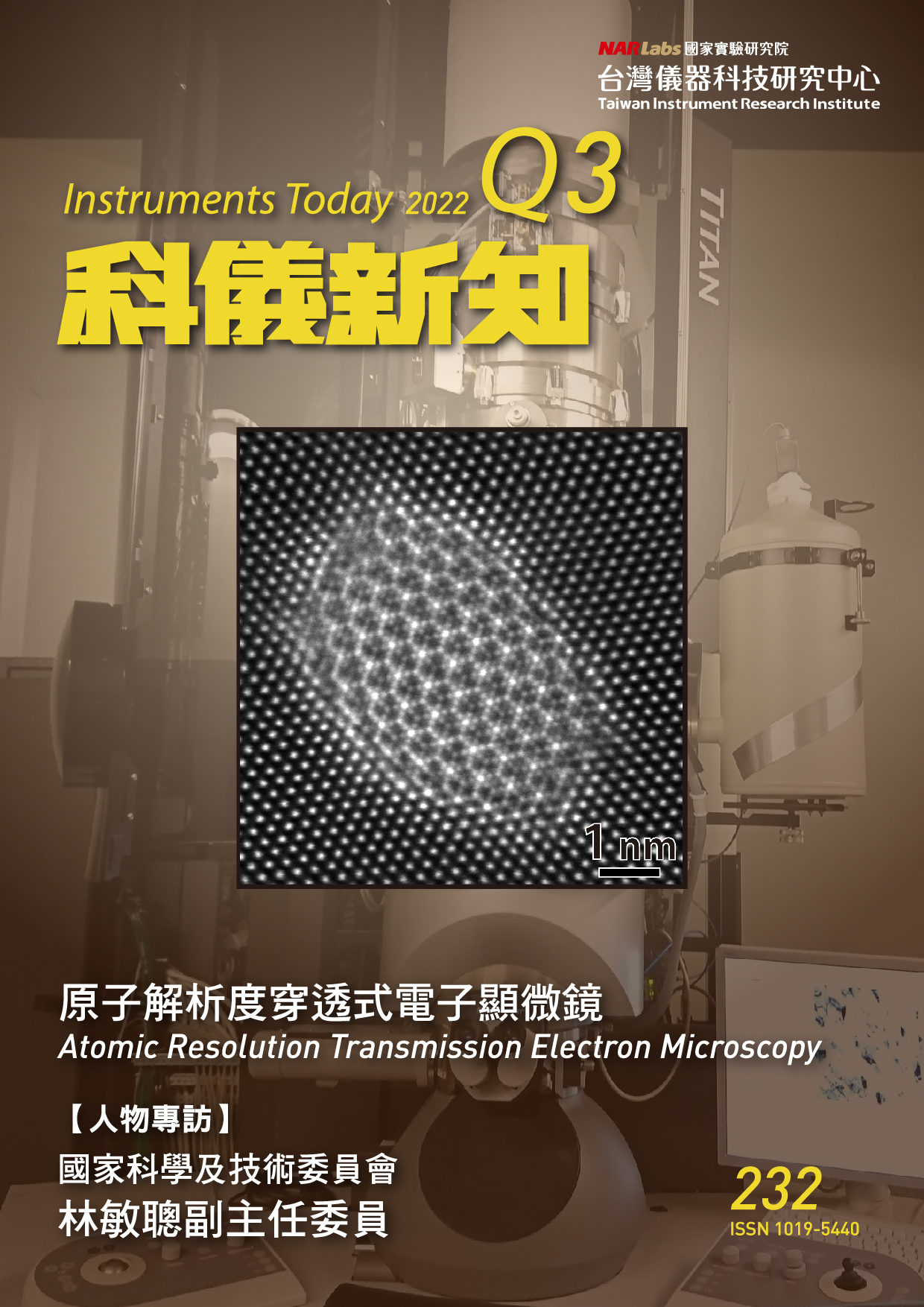
Atomic Resolution Transmission Electron Microscopy

Special Issue Introduction of “Atomic Resolution Transmission Electron Microscopy” [ 下載 PDF ]

Chien-Nan Hsiao


Review on a Atomic-scale Investigation of the Microstructure Evolution of Nanoscale Precipitates in 7xxx Series Aluminium Alloys [ 下載 PDF ]

Tsai-Fu Chung, Yo-Lun Yang, Chien-Nan Hsiao, Cheng-Si Tsao, Wei-Chih Li, Jer-Ren Yang

Multi-types of η precipitates are created in the advanced and high-strength 7xxx series (AlZn-Mg-Cu) aluminium alloys, subjected to the artificial ageing treatment. Employed highresolution transmission electron microscopy (HR-TEM) and Cs-corrected high angle annular darkfield scanning transmission electron microscopy (Cs-corrected HAADF STEM), it can further elucidate the microstructures of η precipitates, such as η1, η2 and η4. Furthermore, the orientation relationships between the aluminium matrix and η precipitates are clearly identified by the fast Fourier transform (FFT) diffractogram and the simulated diffraction pattern. In the present work, it has been found that the atomic edge-on configurations of η1, η2 and η4 are characterized as the zigzag, sandwiched and six-fold atomic arrangements, grown on the (1120)η1, (1010)η2 and (0001)η4 planes, respectively. Additionally, the size, morphology and volume fraction of precipitates can be estimated by small-angle X-ray scattering. We also indicate the nucleation of GPII zones and multitypes of η precipitates on the interface of the AlMn6 second phases. The 3D electron microscopy imaging is presumably to shed light on the 2D microstructures. The beginning of the crystal structure in materials would be supported by the high-end instruments but also the good sample preparation and the cutting-edge image reconstruction.


Rebuilt Space Distribution of Electronic Properties, Bonding Status and Element Compositions by Electron Energy Loss Spectrometer in Transmission Electron Microscopy [ 下載 PDF ]

Tzu-Yi Yang, Yu-Lun Chueh

In this article, we introduce the working mechanism of electron energy loss spectrometer (EELS) in transmission electron microscopy (TEM) and the differences compared with energydispersive X-ray spectrometer (EDS), which is traditional composition analysis method used in TEM. For the composition analysis, the EELS can not only provide more accurate composition quantification of elements with lower atomic number but also distinguish the bonding type by shape of characteristic peaks. Besides, we can know the electronic characteristics, such as band gap and dielectric difference at atomic scale measured positions at plasmon peak region. Furthermore, three cases measured by EELS were demonstrated, including in-situ current-accelerated phase cycling with metallic and semiconducting switchings in copper nano-belts, the working mechanism of MoSe2 spiral nanorods array as cathode in Al ions energy storage battery, and the diffusion of alkaline elements in CIGS thin film solar cell.


Atomic-scale Observation of Materials via in-situ TEM [ 下載 PDF ]

Wen-Wei Wu, Yi-Tang Tseng, Hung-Yang Lo, An-Yuan Hou, Fang-Chun Shen

In recent years, with the miniaturization of materials, studies on nanoscale devices are urgent and valued most by scientists. Under the trend, the development of new materials and the effects from structures and kinetics of nanomaterials are more and more important. Atomic arrangements affect not only the crystallinity, grain boundaries and defects of materials, but also the physical, mechanical and chemical properties profoundly. The distribution of elements decides the composition, phase, segregation and so on, leading to the different materials properties as well. In materials science, it is not easy to obtain direct and strong observation and analysis for the process of many results and phenomena; thus, at nanoscale, directly observing materials with specific external factors, such as electrical field-driven electron transport properties, heat induced atomic diffusion and grain growth in kinetics, structural changes including dislocation movement by stress and defect generation, will provide the most reliable evidence for the relationship between the structures and properties of materials.


The Application of Three-dimensional Atomic Electron Tomography to Semiconductor Devices [ 下載 PDF ]

Yu-Ting Peng, Yu-Lun Liu, Chien-Chun Chen

This article will describe the three-dimensional atomic electron tomography technique, using spherical aberration-corrected scanning transmission electron microscopy (Cs-corrected STEM) to take high-angle annular dark-field (HAADF) images of semiconductor devices specimen without any missing wedges and reconstruct all the projection images into a complete 3D atomic-level model. Taking the ferroelectric fin-field effect transistor as an example, different from the HAADF image in the past, which could only provide a single plane projection, the spatial distribution of the 3D reconstruction model can provide more details analysis and application. With this technique, we are able to observe the sample's internal microstructures, which were difficult to analyze previously, such as atomic-scale interface roughness, which cannot be observed without 3D atomicscale electron tomography. We can understand this technology's latest application and development through the example. Furthermore, in advanced semiconductor analysis and inspection, we can use this technology to obtain complete 3D structure information and observe the subtle defects of advanced semiconductor components, which cannot be detected in other inspection technologies.


Applications of Atom Probe Tomography to Semiconductor Devices [ 下載 PDF ]

Hung-Wei Yen

Atom probe tomography is a state-of-art technique of microscopy and microanalysis, enabling three-dimensional atom distribution of materials and devices. It has been widely applied in the fields of materials, devices, geography and biology and the characterizations of many solids. Its unique spatial resolution and chemical detection limit make atom probe become a critical characterization technique for contemporary devices which are small, complicated and three dimensional. In this article, we provide an introduction to atom probe tomography and further demonstrate some practical cases in semiconductors. Moreover, we address issues on challenges and difficulties of atom probe for applications in future semiconductor. We expect this article is able to make readers and semiconductor experts have clear understanding in atom probe.


A Short Summary of Some Typical Puzzles in TEM Analyses [ 下載 PDF ]

Jong-Shing Bow

Some typical puzzles encountered in using routine TEM/STEM techniques for material analysis, such as TEM alignment, choice of imaging techniques, inadequate applications of HRTEM, false Cu signals in EDS analysis, and EELS mapping in TEM mode, are shortly discussed in this paper.


Colum

Development of Large Aperture Microscope Objectives for Large Biological Samples [ 下載 PDF ]

Wei-Jei Peng, Chih-Wen Chen, Ming-Fu Chen

Light sheet fluorescence microscopy (LSFM) can provide dynamic three-dimensional highresolution image, which is an important technology currently used in biomedical science. In recent years, whole-brain image by LSFM has became a major application in neuroscience. Due to the limited field of view of traditional commercial objectives, imaging stitching is still required to observe high-resolution large biological samples. However, moving the objective lens for stitching is time-consuming, and the stitching traces in the image causes problems such as discontinuity of the image and reduction of resolution. Therefore, a customized microscope objective with a large field of view is indispensable to acquire a high-resolution complete image. According to the requirements of this project, specifications include a wide field of view of Φ 22 mm to detect the whole mouse brain, and a working distance larger than 30 mm to scan deep biological samples. Most importantly, the resolving power should achieve 1 μm to observe living cells. Correction of field flatness and longitudinal chromatic aberration is more challenging due to the wide field of view. The ultra low dispersion material is employed in the achromatic doublets design to correct chromatic shift appropriately. The process of optical design, opto-mechanical design and measurement are described in detail in this study.