2024.6

About Instruments Today No. 239

People

Dr. Chen-Yi Lee, Vice President of National Yang Ming Chiao Tung University: If You Want to Go Fast, Go Alone. If You Want to Go Far, Go Together. [ 下載 PDF ]

Claire Lin


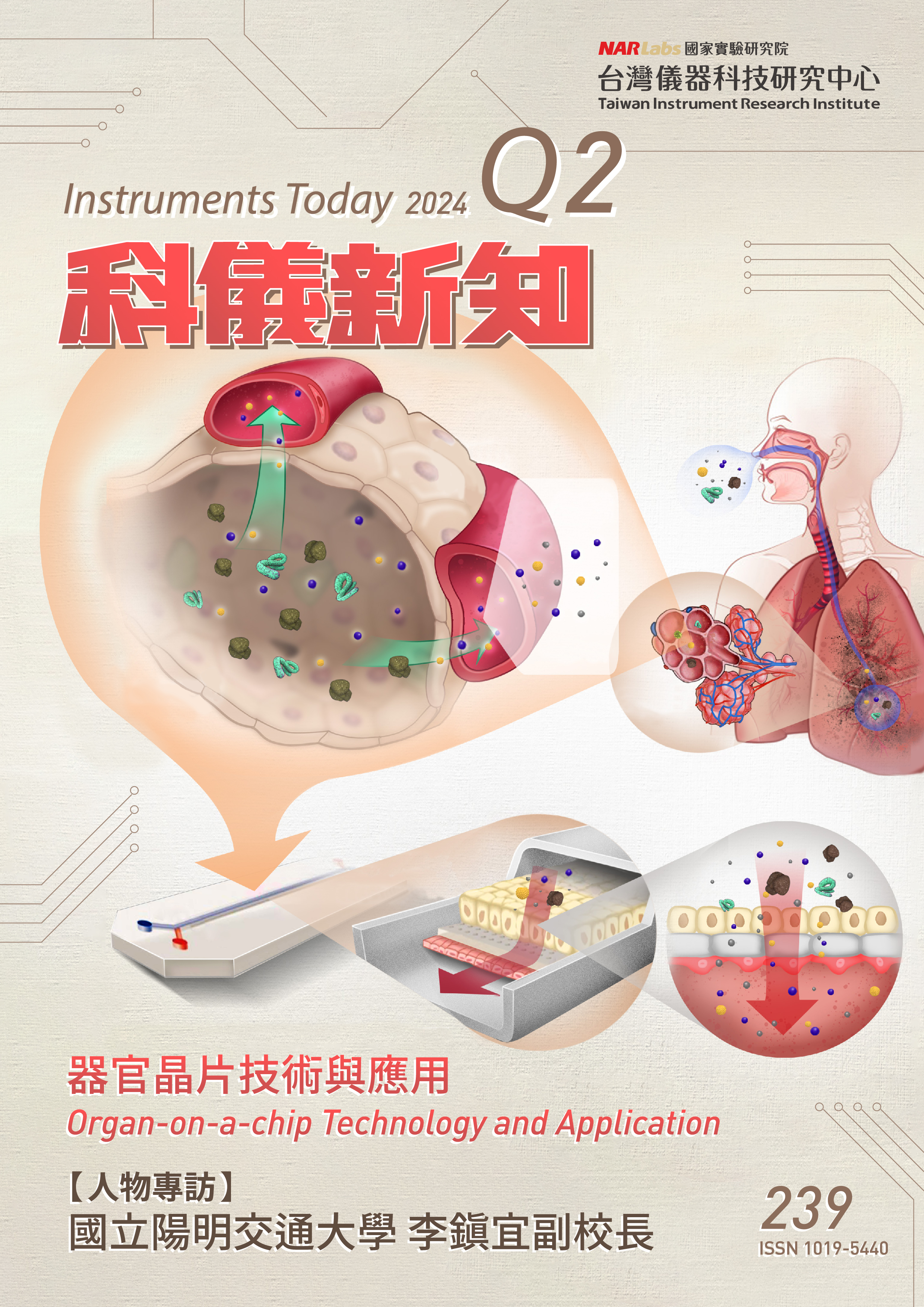
Organ-on-a-chip Technology and Application

Special Issue Introduction of “Organ-on-a-chip Technology and Application” [ 下載 PDF ]

Fan-Gang Tseng


The Current Development of Organ-on-a-chip Technology [ 下載 PDF ]

Nien-Tsu Huang, Yen-Cheng Hsiung, Chia-Pei Wang

Organ-on-a-chip is a novel platform for ex vivo organoid cultivation. The design is based on the lab-on-a-chip concept, consisting of various components such as microfluidics, microsensors, and microactuators. The above components were fabricated by the standard micro-electro-mechanical systems (MEMS) or soft lithography fabrication processes, enabling various biochemical analysis functions to be integrated into a single miniaturized chip. Due to its miniaturization and high-throughput cell incubation and sensing capability, organ-on-achip can handle small volumes of test samples and perform multiplex or multiparallel assay testing, significantly reducing reagent costs and testing time. In this article, we introduce the key components of organ-on-a-chip systems, including the geometry design and material selection of microfluidic chips, microsensors, and fluidic control systems. We also list several representative organ-on-a-chip systems in academic fields and commercialized organ-on-a-chip products in recent years. Finally, the challenges and future development directions of organ-on-a-chip are also discussed in this article.


Organ-on-a-chip Technology and Application – Taking Lung-on-a-chip as an Example [ 下載 PDF ]

Guan-Yu Chen, Ang-Tung Shih, Shan-Hsuan Li

For a long time, animal testing has played a crucial role in the development of new drugs. However, an increasing number of studies have shown significant differences between the results of animal experiments and human clinical trials, highlighting the need for more effective testing methods to predict the efficacy and safety of drugs in humans. Among these, organ-on-a-chip (OoC) technology, with its ability to accurately simulate complex bodily structures and cell physiology, offers more precise and reliable experimental outcomes, thereby accelerating the preclinical drug development process. This technology has garnered immense international attention in recent years. This article will sequentially introduce the background of OoC research, its core technologies, and present the lung-on-a-chip (LoC) as an example to illustrate related application instances.


Tumor Microenvironments on a Chip for Drug and Immune-response Screening [ 下載 PDF ]

Shang-Hsiu Hu, Min-Ren Chiang, Hoi Man Iao

According to a new statistical study published by the National Cancer Institute (NCI), the number of cancers in older adults in the United States will increase significantly in the next 30 years. It is estimated that the number of cancer patients in the United States will increase by 11 million in 2040 (from 61% to 73%), will be the cancer silver tsunami in the next 30 years. Taiwan’s aging society will also lead to a rapid increase in the number of cancer cases. According to statistics from the Ministry of Health and Welfare, Taiwan’s cancer mortality rate is close to 30%, ranking first among the top ten causes of death in the country. Although many researchers are committed to developing effective drug delivery systems to improve cure rates and reduce chemotherapy side effects, the results are still limited, mainly due to the complexity of the tumor microenvironment, which results in errors in in vitro drug screening and causes many clinical problems. In order to achieve the purpose of accurately simulating the tumor microenvironment in vitro, many research concepts are to develop tumor microenvironment on a chip (TMoC), which can be used to quickly screen and evaluate the penetration of drug carrier systems into tumors, and screen Characteristics of chemical drugs and immunotherapy, and understanding the impact of tumor microenvironment on drugs and immunotherapy. The TMoC contains more than hundreds of three-dimensionaltumors (including blood vessels, fibroblasts, cancer cells, cancer stem cells, and macrophages). The penetration and therapeutic effect of the drug carrier can be evaluated in a timely manner, and the correlation between each cell can be observed and assess overall cellular changes under the influence of T cells.


Exploring the Potential of Cancer Chips in Novel Drug Development and Clinical Drug Guidance [ 下載 PDF ]

Chiao-Min Lin, Jen-Huang Huang

The complexity of cancer research and treatment is rooted in the intricate microenvironment of tumors. Challenges emerge at each phase, ranging from the initial stages of drug development to the process of selecting drugs for clinical application. This limitation arises from the challenges faced by existing in vitro or animal models in accurately reproducing this complex scenario. The development of cancer chips offers promise in addressing this challenge. Recent advancements in chip manufacturing have led to the maturation of technology that more accurately mimics the tumor microenvironment. This article presents the evolution of cancer chips and our team's novel technology, with the objective of providing innovative pathways for cancer research and the advancement of therapeutic drugs in the future.


A Microfluidic 3D Cell Spheroid Co-culture Technique for Tumor Angiogenesis Testing [ 下載 PDF ]

Didem Rodoplu Solovchuk, Jefunnie Sierra Matahum, Chia-Hsien Hsu

In-vitro tumor angiogenesis models can be used for studying the mechanisms of tumor angiogenesis and testing anti-tumor-angiogenesis drugs. Co-culturing of embryoid bodies (EBs) and tumor spheroids (TSs) allow mimicking tumor angiogenesis in-vitro. Here, we report a microfluidic hanging drop-based spheroid co-culture device (μ-CCD) that permits the generation and co-culturing of EBs and TSs using a simple manual operation procedure and setup. In brief, uniform-sized EBs and TSs can be generated on the device in eight pairs of hanging droplets from adjacent microfluidic channels, followed by the confrontation of EB and TS pairs by merging the droplet pairs to culture the EB-TS spheroids to investigate tumor induced angiogenic sprouting. The physical parameters of the device were optimized to maintain the long-term stability of hanging droplets for up to ten days. Mouse embryonic stem cell line ES-D3, and breast cancer cell lines MDA-MB-231 and MCF-7 cells were used to generate EBs, invasive TSs, and non-invasive TSs respectively. The confocal imaging results showed that the vessel percentage area and total vessel length which are linked to tumor-angiogenesis, all increased after 6-days of co-culturing. An antiangiogenesis drug testing on the co-cultured EB-TS spheroids was also demonstrated in the device. The above results show that the μ-CCD can provide a simple yet high-efficiency method to generate and co-culture cell spheroids may also be useful for other applications involving spheroid coculturing.


Perfusion 3-D Cell Culture Microfluidic Chip for Drug Testing [ 下載 PDF ]

Min-Hsien Wu

An in vitro cell culture model that can faithfully reflect the response of drugs in the human body not only avoids the use of experimental animals, but this biomimetic model can also save time and cost in drug research. To achieve this goal, the use of microfluidic chips for perfusionbased three-dimensional (3-D) cell culture is considered to have potential. This article will first provide some background information, including the role of cell culture in drug development, the significance of perfusion 3D cell culture, the advantages and disadvantages of using microfluidic technology to perform this type of cell culture, and the considerations for constructing this cell culture model. Finally, this article will introduce a simple and easy-to-operate microfluidic-based perfusion 3-D cell culture system.


Integration of Dielectrophoresis Technology with Organ-on-a-chip for Screening Liver Cancer Drug [ 下載 PDF ]

Zih-yin Chao, Tsai-Yu Shih, Xiao-Han Wang, Wei-Lun Sun, Kang-Yun Lee, Ke-Shun Wang, Cheng-Hsien Liu

The treatment of cancer has consistently been a primary focus of medical research. Microfluidic technology and highly biocompatible materials simulate the physiological conditions of human organs and tissues in vitro. This approach is utilized to create various biomedical chips that mimic the complex environment of tumor microenvironments. Through the utilization of minute quantities of samples and chemicals, precise experimental outcomes can be achieved. Furthermore, our design includes multiple array-type chambers that feature distinct tumor microenvironments. The chambers regulate diverse conditions, including oxygen and pH concentrations, and employ dielectrophoretic force to facilitate interactions between cancer cells and fibroblasts. The presence of multiple chambers enables the concurrent performance of diverse biological detections and drug selections on a singular chip, thereby improving experimental efficiency and minimizing the duration of experiments. It is anticipated that personalized chips will be employed in evaluating immunotherapy, chemotherapy interventions, or targeted drugs to assess the extent to which external factors influence the relationship between test outcomes and patient therapy. The objective is to enhance the accuracy of auxiliary treatment information provided by the chip, facilitate more precise personalized medicine for diverse patients in the future, and alleviate medication-induced discomfort. This novel organ chip offers an efficient and cost-effective platform for drug development in cancer treatment and pathological research. It also functions as a crucial point of reference for clinical interventions and facilitates the creation of a personalized chip tailored to the patient’s sample.


A Cardiac-chip Integrated with a Piezoelectric Thin-film Sensor and its Application of Drug Screening [ 下載 PDF ]

Kuan-Wei Chen, Yun-Han Huang, Chiou-Fong Yang, Yu-Hsiang Hsu

The cardiac chip represents a sophisticated and distinctive system within the realm of organon-a-chip (OoC) and microphysiological systems (MPS). The phenomenon can be attributed primarily to the excitation-contraction coupling mechanism of cardiomyocytes. Hence, it is crucial to observe the force contraction characteristics of cardiac tissue to investigate the effectiveness of cardiovascular medications and the cardiotoxicity of non-cardiac drugs. Currently, the prevailing approach for assessing the myocardial reaction to drugs involves utilizing a high-resolution optical system for visualizing sarcomere contractions; however, this method is constrained by its limited throughput capacity. Conversely, the genetic variations between animals and humans prevent the extrapolation of low efficacy and severe cardiotoxicity until human studies are conducted. Hence, pharmaceutical companies continue to face a challenge in finding a dependable in vitro cardiac model equipped with automatic detection capabilities. In this investigation, an innovative hybrid system integrating cardiac and piezoelectric components is developed. The fundamental technology involves the cultivation of cardiac tissue using human-induced pluripotent stem cell-derived cardiomyocytes (hiPSC-CMs) on a piezoelectric thin film. Electrophysiological stimulations and microgrooves are employed to establish a microphysiological environment that enhances the maturation and synchronization of cardiomyocytes. Subsequently, the cardiac contraction profile can be directly deduced from piezoelectric signals. The cardiac-and-piezoelectric hybrid system offers the advantage of utilizing piezoelectric signals to directly monitor the contraction behavior of cardiac tissue under various drug dosages. Additionally, it enables quantitative analysis of contraction frequency and force. Consequently, it is capable of determining the median effective concentration (EC50) or median inhibitory concentration (IC50) of drugs.