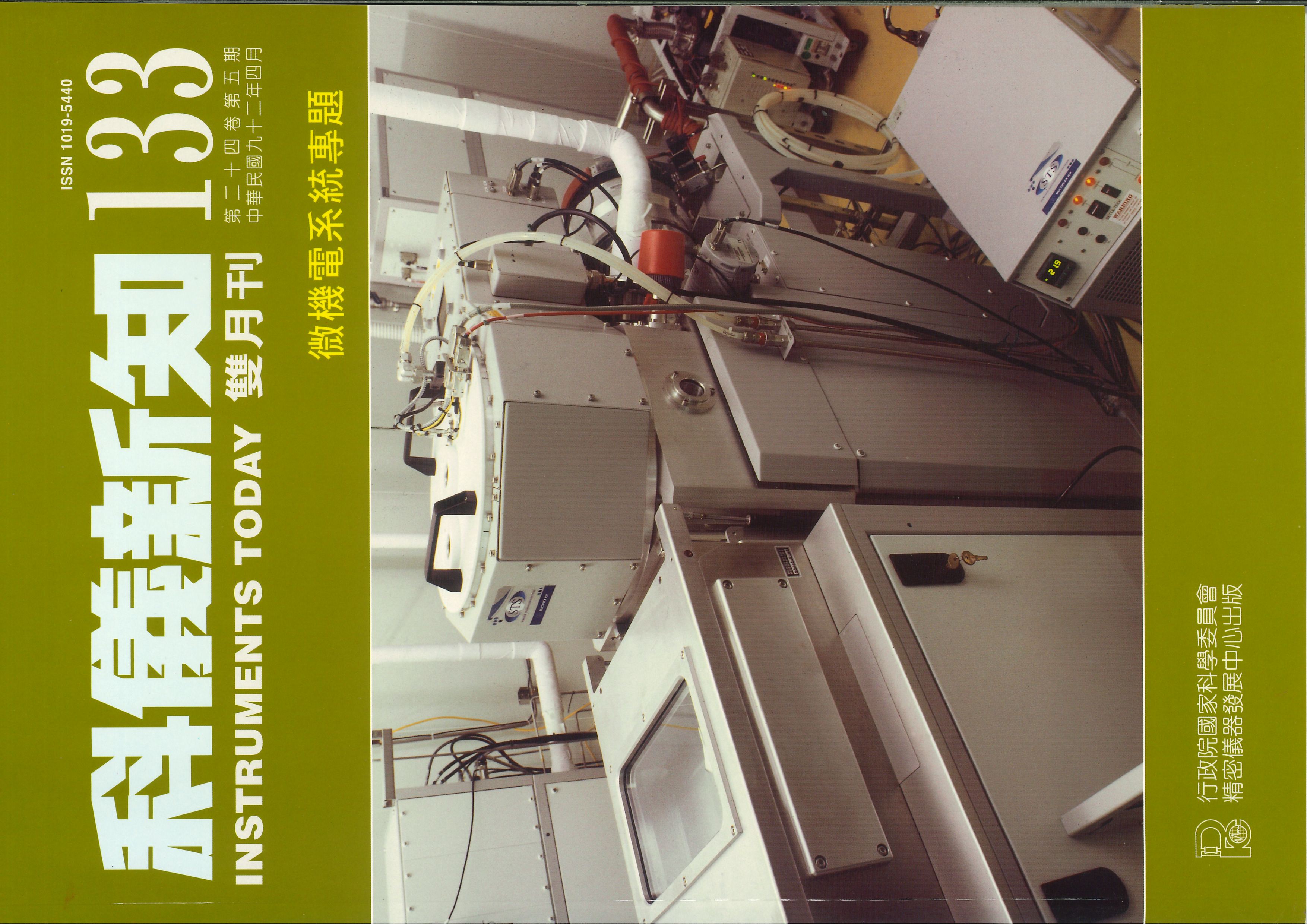
2003.4
About Instruments Today No. 133
Micro-Electro-Mechanical Systems
Application of MEMS Fabrication Process for Optical Switch Development [ 下載 PDF ]
Chii-Rong Yang, Po-Ying Chen, Chin-Chieh Chao
Because the enormous spread of the Internet and the rapid increase of multimedia transmission data in 21st century, human beings have entered a pluralistic information era by broadband telecommunication application for integrating voice, data, and multimedia transmission. The miniaturized, integrated, and arrayed optical switch will be realized low costly and batchedproduction through MEMS fabrication processes. In this article, firstly the characteristic and applications of various typed optical switch are introduced. Moreover, the practical examples of optical switch based on MEMS processes are also presented. Furthermore, the principles of evaluating the suitability in optical switch are also described.
High Resolution X-ray Micromachining Using SU-8 Photoresist [ 下載 PDF ]
Bor-Yuan Shew, Jui-Tang Hung, Tai-Yuan Huang, Kun-Pei Liu, Chang-Pin Chou
In this study, the feasibility using SU-8 as a high contrast X-ray photoresist was investigated. The results indicated that SU-8 revealed very high lithographic contrast other than its superior sensitivity. That means very thin mask absorber is required to switch the negative resist 'ON' and 'OFF'. Once the required absorber thickness could be effectively reduced, high-resolution mask can be easily patterned by conventional UV lithography. Probably, extra soft X-ray beamline is not needed to extend the absorber thickness in certain cases. This exploration will remarkably simplify the fabrication process of the membrane X-ray mask. X-ray micromachining technique will be more accessible for innovative optical and photonic applications.
The Microsensor Technology Using to Identify the Initiation Time of Impact Induced Elastic Waves [ 下載 PDF ]
Lung-Jieh Yang, Tsung-Tsong Wu
The microsensor technology was used here to identify the initiation time of an impact shock. The shock excitation caused by an impact sphere with a diameter of 6 minimeters could generate transient elastic waves in concrete structures. Such elastic waves with frequency above 100 kHz are the active emission sources for defect detection in the non-destructive testing (NDT) of concrete using transient elastic waves. In this paper, an impact sphere, which was packaged with a piezoresistive microsensor, was fabricated to verify this new idea. The microsensor after packaging has the maximum output voltage of 100 mV and the rise time less than 5 microsecond subjected to a sphere impact. The promising result of the initiation time experiment showed that the calibrated (short circuit) signal was left behind the microsensor signal for 40 nanoseconds.
Introduction to Microsystems Packaging [ 下載 PDF ]
Jung-Tang Huang, Jun-Xian Chen, Fong-Rong Lin, Cheng-Jien Peng
Microsystems packaging is to assemble and encapsulate the core structure of the device. The function of the package is to protect the fragile and delicate MEMS devices, such as sensing or actuating elements from the intrusion of the environment such as mechanical force or contamination. Also the package is responsible for mechanical support and provides interface for input and output signal. In this article we will introduce the fundamentals of the package design, the features of the sensor package, a variety of popular low-level packaging techniques, and the multiple wafer-level package.
Fabry-Perot Type Anti-Reflective Coating for Deep Ultraviolet Binary Photomask Applications [ 下載 PDF ]
Hsuen-Li Chen, Hsu-Chun Cheng
In this article, we demonstrated an anti-reflective coating structure for deep ultraviolet binary mask, which is based on three-layer metal interference or called Fabry-Perot structure. The anti-reflective coating structure is composed of the metal/oxide/metal stack. By adding different optimized structures, reflectance of less than 1.5% at both 248 nm and 193 nm has been achieved. At the three-layer Fabry-Perot structure, the bottom chrome layer provides suitable absorption. By controlling the thickness of the intermediate silicon oxide layer, we can tune the minimum reflection regime to the desired exposure wavelength. The top metal layer can prevent charge accumulation during e-beam writing.
The Principle and Applications of Total Internal Reflection on Biological Fluorescence Microscope [ 下載 PDF ]
De-Ming Yang, Hsia Yu Lin, Din Ping Tsai
The developments and applications of biological fluorescence microscope had achieved to a status of maturity and versatility due to the usage of vital fluorescence labeling technique such as green fluorescence protein (GFP) and optimized optical techniques. The biological fluorescence microscope has been a popular tool in experimental sciences. In this article, the authors introduce an alternative type of biological fluorescence microscope-total internal reflection fluorescence microscope (TIRFM). The basic principle of TIRFM is to generate an evanescent wave at the interface of the total internal reflection. The limited depth of the evanescent filed can excite the fluorescent labeling molecules at the very shallow surface of the sample. TIRFM detects only the fluorescence image of the sample surface without the conventional background, and can be effectively applied to the study of biological sciences.
An Evaluation for the Geometric Properties of VCDi Band 2 Image Module [ 下載 PDF ]
Shiou-Gwo Lin, Ting-Ming Huang
This paper introduces the Vegetation and Change Detection imager (VCDi) Band 2 image module and it's geometric calibration process. Estimating accuracy of VCDi image by comparing air-borne orthog raphic image with ground control points. Pairs of image and ground coordinate at five boundary points and one central point are used as controls to estimate transformation coefficients, the estimated residual is 0.51 pixel (around 25.7 cm on ground). At 8 check points, RMS is 0.74 pixel (37.5 cm) on X-axis and 0.45 pixel on Y-axis (22.6 cm).
The Calibration Method of Optical Scale [ 下載 PDF ]
Chieh Ho
Optical scale is usually made of glass and used as a dimensional standard. It can be used as a calibration standard for the calibration of the profile projector (optical comparator) and also the measuring microscope. This paper presents the calibration method of the optical scale. The scale is put on the measuring microscope for observation. The distance moved on the scale (also the microscope) is compared to the laser interferometer instruments. Although the laser measurement system has been used in dimensional measurement and calibration for a long time, readers do not have the chances to understand the theory and technology of this kind of instrument. Hopefully this paper will help some of them to understand the importance of scale calibration.
Introduction of the Technology of Electronic Nose [ 下載 PDF ]
Ren-Jang Wu
For the necessity of various application and samples fast analyzed electronic nose become more popular analytical instruments This paper described the content of the introduction of electronic nose theory of smell and odorous molecules history of the technology for electronic nose the sensing theory of electronic nose and current development of the roadmap of products in the world Maybe this paper work would be helpful for some researchers or someone interested.