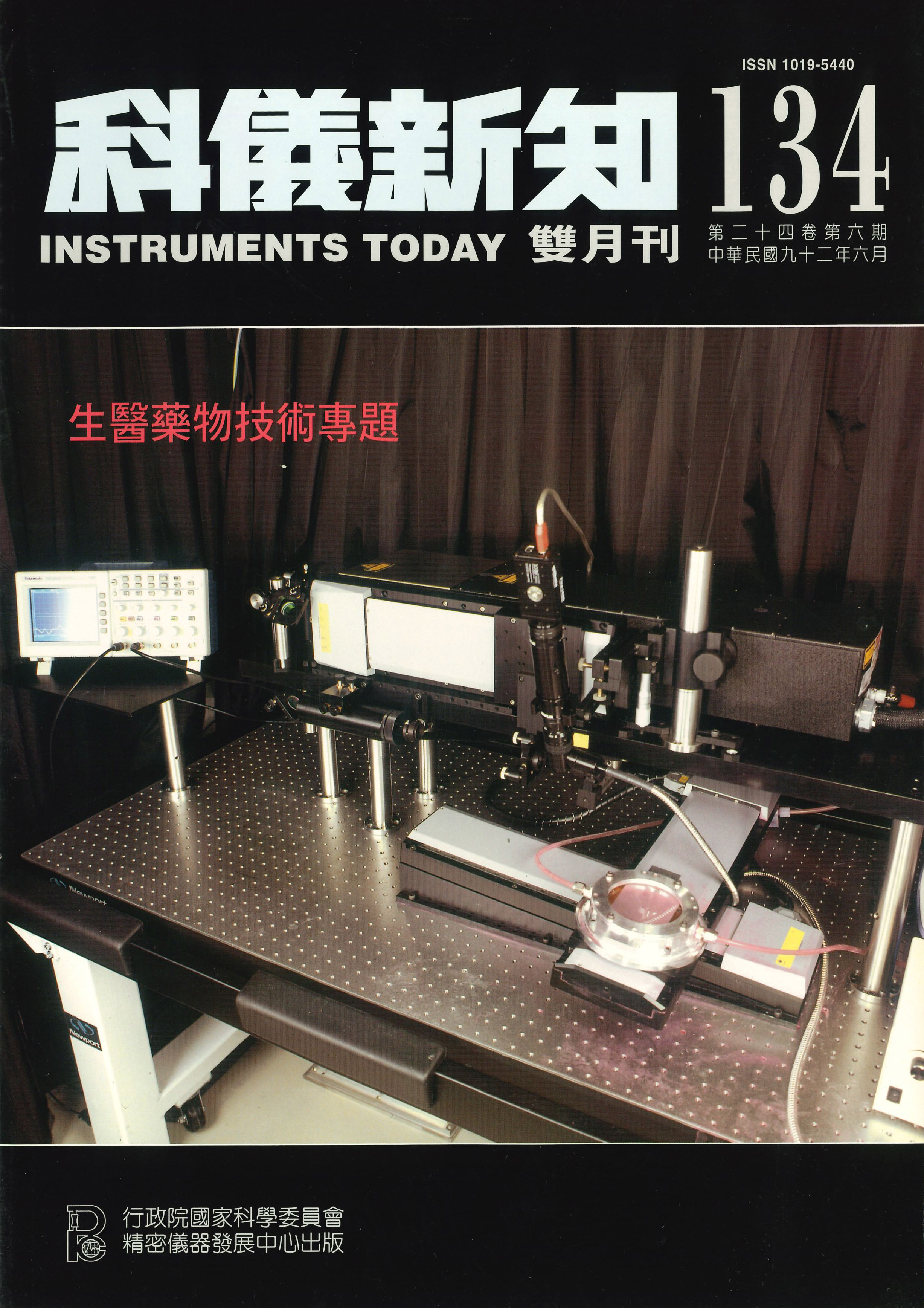
2003.6
About Instruments Today No. 134
Biomedicinal Technology
Real-time Quantitative Polymerase Chain Reaction [ 下載 PDF ]
Yen-Ru Pan, Jing-Jer Lin
Polymerase chain reaction (PCR) revolutionizes the detection of DNA and RNA that both are important for life. Crediting to PCR, any particular sequence, even with little amount as single copy, can be amplified and detected. However, earlier studies are restricted in qualitative analysis, such as sequencing and cloning. To achieve quantitative purposes, the real-time PCR technology has been greatly improved that enables accurate quantitative detection of DNA or RNA samples. Compared with the endpoint measurement in traditional PCR, real-time PCR provides more detailed kinetics and reproducible results since it relies on exponential phase of PCR rather than endpoint. Using either fluorogenic probes or DNA binding dyes, detection of PCR products can be performed to quantify copy numbers of target genes in genome, measure the expression levels of one or multiple genes, analyze mutations, and genotype the single nucleotide polymorphism (SNP). In the past ten years, PCR has brought breakthrough in life sciences for its convenience in amplifying diminutive molecules to analyzable amounts. Undoubtedly, real-time PCR plays vital roles in quantification and qualitative analysis, and will continue expanding its uses in various research fields.
The Applications of Microfluidic System in Pharmaceutical Discovery and Drug Delivery [ 下載 PDF ]
Chien-Ju Hsieh, Chih-Ting Huang, Cheng-Wey Wei, Meng-Hua Yen, Ji-Yen Cheng
This paper reports the combinations and applications of microfluidic system in the fields of pharmaceutical discovery and drug delivery. The minimization of devices will improve the efficiency and accuracy in candidate compound screening and reagent delivery. Because of the diversity, microfluidic system becomes a new field for research. The advantages of microfluidic system includes low-cost of instruments and fabrication, reduced sample quantity and reagent amount, reduced reaction time, and minimized device dimension. The future work to improve microfluidic system includes enhanced throughput, enhanced reliability, high sensitivity and convenient operation. The major challenge in the drug delivery system is to find a biocompatible substrate material to be used in biomedical devices. Microfluidic system has been applied in many disciplines now, and this paper focuses on the applications of drug delivery and development.
Photodynamic Medicine for the Management of Dysplasial Lesions [ 下載 PDF ]
Tsuimin Tsai, Chin-Tin Chen
Photodynamic medicine consists of photodynamic diagnosis and therapy, which has been applied for the management of neoplasia lesions. Presently, photodynamic therapy has been approved clinically for cancer therapy in USA, European unions and Japan. The concepts and application examples will be discussed and introduced in this article.
Spectroscopic Investigation of Thionin-Telomere Interaction and Development of Telomere Stabilizer [ 下載 PDF ]
Ta-Chau Chang, Cheng-Chung Chang, Jin-Yi Wu
During cell division, the telomeric sequence will be shortened and eventually lead to cellular senescence. The enzyme telomerase allows the elongation of telomeric DNA. Although telomerase appears in more than 85% of tumor cells, it is not expressed in most somatic cells. Therefore, a number of aromatic molecules have been investigated for their ability to stabilize quadruplex structures and to inhibit telomerase activity. Here we have used induced circular dichroism to study the binding of thionin molecule to various guanine-rich quadruplexes. Our results show that external stacking on the end surface of the G-quartet associated with electrostatic interaction with the loops or tails is the major binding mode of thionin with these G-quadruplexes. Absorption titration and competition dialysis were applied to measure the selectivity and binding affinities of the molecule to various DNA. Melting temperature and telomerase IC50 were measured for drug screening. We have synthesized a new molecule of 3,6-bis-(1-methyl-4-vinylpyridium iodine) carbazole (BMVC) for stabilizing the quadruplex structure of human telomeric sequence of d(T2AG3)4 and inhibiting telomerase activity. In addition, significant increase of the fluorescence of the BMVC upon interacting with the d(T2AG3)4 may allow it as a useful G-gucdruplex specific bio-marker.
The Retrospect and Prospect of in vitro Tumor Invasion Assay Techniques [ 下載 PDF ]
Wun-Shaing W. Chang, Sheng-Chieh Lin, Kai-Chun Lin, Yu-Rung Kao, Ruey-Hwang Chou, Chia-Yi Chi, Cheng-Wen Wu
Tumor invasion plays an important first step in complex metastatic process. To understand this physiological event, over the past few decades scientists have tried to utilize different animal species to help study the invasive properties of malignant tumors. Several alternative measurements, however, have been developed to replace animal experimentation. These in vitro invasion techniques not only provide a valid model but also offer a rapid, simple and versatile system for cancer metastasis research. Here we reviewed the overall progress of these invasion assays and, based on the current problems, proposed a better, cheaper, and more consistent chamber design for the in vitro tumor invasion assay.
Applications of Matrix-Assisted Laser Desorption/ Ionization Time-of-flight Mass Spectrometry in Life Sciences Research [ 下載 PDF ]
Chau-Chung Han
The author introduces biotechnological applications of matrix-assisted laser desorption/ionization mass spectrometry with his personal hands-on experience as examples. These include rapid microbial identification, rapid herbal identification, and development of new generation mass spectrometric technique for potential applications to the imminent needs of nano-scale sciences. References cited are very useful to those readers who wish to gain a broader overview of the applications of mass spectrometric techniques to contemporary life science research.
Force-Measuring Instruments — The Introduction of Proving Ring [ 下載 PDF ]
Chieh Ho
Proving ring is the standard of force-measuring instruments. The Morehouse universal calibrating machine is used to compare the force standard with respect to the unit under test. A hydraulic jack is used to press both rings. The deflection of the ring is measured by a micrometer head inserted in the center diameter of the ring. This is the principle of force calibration. The precision requirement of force calibration on force-measuring instruments is getting pretty hot recently. Since the force calibration laboratory in our section has done well in the force proving test. This paper would like to present you the calibration methods of the proving ring and some skills of operating this precision force calibration system. Hopefully those who are interested in force measurement will understand the technology in this field.
A Numerical Analysis of Mixing Characteristics and Optimal Designs of a Micro Mixer [ 下載 PDF ]
Jyh-Jian Chen
Computational fluid dynamics simulations are utilized to study the mixing characteristics of a passive micro mixer. The device is based on a hexahedral structure accompanied with several input and output micro channels. The influences of various operating and design parameters on mixing of two fluids are analyzed. Results show that the relative locations of the inlets in the mixer, the numbers of channels, the Reynolds number of fluids and the width of outlet can affect the mixing effect. Regarding to the lower pressure drop, the optimal design parameters are chosen according to our calculated results.
Laser Confocal Microscopy [ 下載 PDF ]
I-Chuan Chuang, Huei-Sheng Huang, Hsien-Chang Chang
To get real and accurate images of a measured target is the final goal of microscopic techniques. We use confocal laser microscope to eliminate the noise in order to get single-point images. It can also be combined with single wavelength laser, scanner and computer to observe internal structures of samples by optical slices and without destroying the samples. Confocal laser microscope can actually display the fine structures of the sample in three dimensions and has been already widely used to observe the fluorescence-labeled samples in biomedical field. The advantages of confocal microscope are excellent resolution, strong signals, low background noise, precisely stereo-type localized and optical slices available. So confocal laser microscope plays an important role in the fields of biomedicine, tissue engineering and material techniques.
High Speed Cell Sorter [ 下載 PDF ]
Richard Huang
This article summarizes the principle, component’s description, new technical innovation of high speed cell sorter, as well as some major applications of flow cytometry in research field. The basic components of the flow cytometry include: laser light source that was used for providing the energy to the fluorescence dye; fluid system used to regulate the flow of sample stream containing particles through the laser illuminating area; optical system to direct and separate the different fluorescence wavelength to individual photomultiplier tube; electrical system for measuring the voltage pulse signals and converting to digital signals for computer system; the computer system to analyze all digital data and present by plot; in addition, sorting system for obtaining pure preparations of particles with certain kinds of characteristics of interest. In briefly, the particles to be measured are introduced into the center of a fast moving fluid stream and passing through the laser illuminating area, the scatter and fluorescence signals generated by particles are collected by detector and analyzed by computer. Besides the above description of principle and components of flow cytometry, some research applications is also discussed.